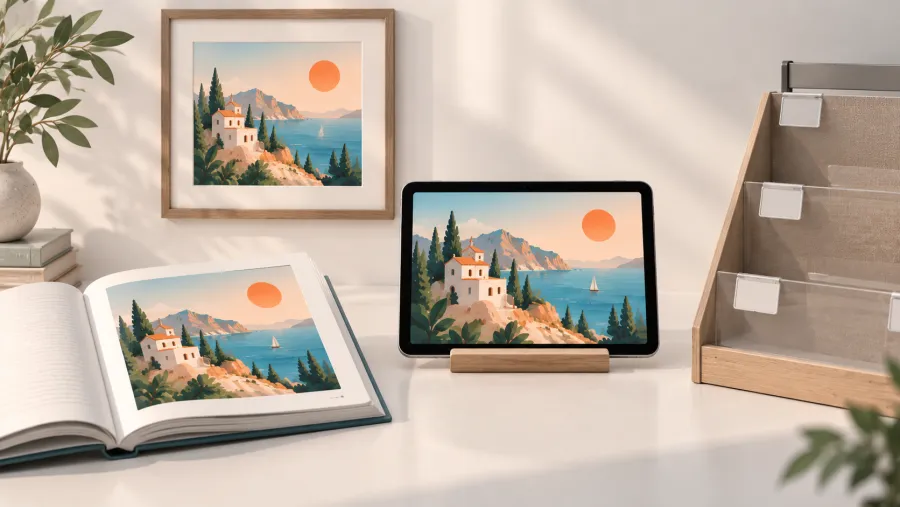
Rights to stock images: what you can and cannot do
In brief
You can use it however you like, including commercially, with no limits on term or territory; you do not need to credit the source. · The main line: you cannot resell the files themselves as goods — a picture is bought for your design, not for your merchandise. · The license is non-exclusive: other people can buy the same picture. This is normal practice for any library — and the reason for the price.
What you get
With the purchase you get the image files and the right to use them in any lawful way. This right has no term — what you bought does not expire after a year and needs no renewal. No territory — it works anywhere. No obligation to credit the source — you do not have to label the pictures “taken from such-and-such”; the design stays yours and looks yours.
This is worth saying because many libraries do it differently: licenses with limits on print runs, on how long an item can be displayed, or with a mandatory credit. There is none of that here — the right is simple and complete.
What you can do
Practically everything people buy pictures for. Advertising — from a banner to a print layout. Artwork for books, episodes, videos. Design for social media and channels — feeds, posts, headers. Print — posters, handouts, printed matter. Presentations and courses.
Client projects deserve a separate mention. If you design for a client, you can use the pictures you bought in their project: you are buying the right to use them in your work, and work for a client is the same kind of use.
What you cannot do
The main restriction: you cannot resell the files themselves as goods. You cannot put them up for sale individually or in sets, spread them across other marketplaces or offer them as your own catalog.
The logic of the line is simple. You buy a picture so that it works in your design — becomes a header image, a post, a slide. That is use. Putting the same files up for sale is no longer use but trading in someone else’s material, and we protect that material. The difference is like buying fabric for a dress versus reselling a whole roll from your own warehouse.
| You can | You cannot |
|---|---|
| use them in ads, as artwork, in posts and presentations | sell the files themselves individually or in sets |
| print them — posters, layouts, printed matter | spread the files across other marketplaces as a catalog |
| use them in projects for your own clients | pass the files off as goods of your own making |
| use them with no term, no territory, no credit to the source | — |
What “non-exclusive” means
The license for stock images is non-exclusive. This means that different buyers can buy the same picture: after your purchase it is not withdrawn from the library and stays available to the next buyer.
This is how any library of ready images works, and it is exactly why stock images are affordable. You pay for the right to use, not for the picture to become yours alone — that would cost entirely different money.
Let us be honest about the flip side too: when you buy stock, you accept that the same picture may turn up in someone else’s design. For most tasks this is not a problem — the set is still yours, the combination of pictures is yours, the presentation is yours, and nobody can repeat the row you put together as a whole. But if it is critical for your project that nobody else has the images, stock will not fit by its very design.
When you need uniqueness
Then it is a series to order: its images are created for the client, are not passed on to anyone else and never go into the stock library. The two offers complement each other: stock is fast, affordable and from a shared library; a series is yours alone, drawn from your own subjects. How to choose between them — a separate comparison.
What it looks like in practice
The terms of purchase are published on the site — they are the same for everyone and not hidden in footnotes. After payment the archive appears at once, and an email with the order details arrives in your inbox. You do not need to sign any additional agreements: you bought it — you use it, within the limits described above.