«Medium shot: a monorail train of structurally identical carriage modules recedes into perspective above the city — sections painted differently, one silhouette. Even daylight, clean forms.»
Describe your own scene — and get a series in the chosen style
Open the “Concept Art” styleCovers for a book series, courses and articles: a series that turns a project into a publication
In brief
A publisher’s look = a shared base + the same font. The series gives you the first, you add the second. · Books are vertical, courses and articles horizontal. Scenes go to cycles, modules, topics. · Commercial use is standard: books for sale and paid courses.
Book series and self-publishing: vertical format
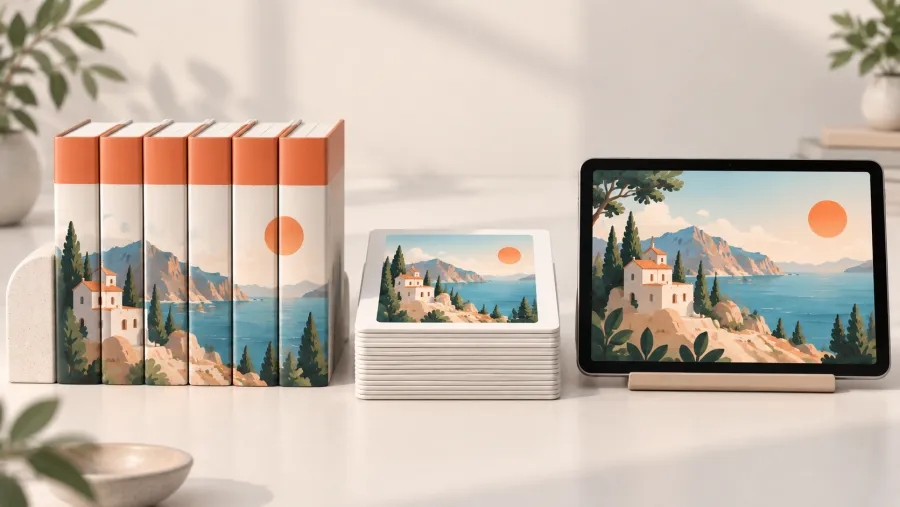
For books — from self-publishing and fiction to textbooks and popular science — the series is made in the vertical 2:3 book format. Thirty bases in one manner are a stock for years of series work: volumes written, volumes planned, announcements and release posters.
The formula of a publishing line has two halves. The series gives you the first — a single visual base. You add the second: the covers deliberately have no text, and the title and author’s name are set in your font — the same way on every volume, the same place, the same character of type. A single base plus the same font — and the shelf looks as if it came from one workshop.
If you have several lines — a main cycle and collections, an adult and a children’s series — separate them by scenes: each gets its own subject within the shared style, and readers tell the cycles apart at a glance.
Courses, presentations, talks: horizontal format
Title slides for lectures, online course modules, pitches and talks are made in the horizontal 16:9 format. A listener’s trust begins with the first slide: a course where every module opens with the same design reads as a well-built program. Here it is convenient to lay out the scenes by course module or by type of session — lectures, workshops, reviews.
A special convenience for this audience: the series can easily be bought on behalf of a company. Companies can pay by invoice — it is generated on the site at once, with a printable version, and closing documents are provided.
Articles and blogs: a column becomes a publication
Header images for blog platforms and corporate blogs are also horizontal. The logic is the same as with a bookshelf: articles with consistent header images add up to a recognizable column, and regular readers find your piece in the feed by its cover. If you write on several topics, the scenes become visual sections: the topic is read from the image before the headline.
The shared part — one for all three tasks
The series is about thirty unique covers in one style, a one-time purchase with no subscription. You choose the style in the library by shelf — from painterly manners to strict minimalism — by its live samples. The scene subjects are already filled with suggestions: accept them, edit them or write your own.
Every cover exists in a single copy — you will not meet it on someone else’s book or course. You can use the series in any lawful way, including commercially: books for sale and paid courses are a standard case, and you do not have to credit the source. The archive arrives in your account within a day and is kept there for thirty days; you can repeat the order within a month.