«Medium shot: a station control room, five holographic domes in a row on one technical frame, each with its own world — desert, ocean platform, city, glacier, greenhouse. Cold blue light of the projections.»
Describe your own scene — and get a series in the chosen style
Open the “Concept Art” styleWhat a scene is and how many to take: the range of a series in one style
In brief
A scene is a subject within a style. One to five of them; the scenes do not have to be connected. · The number of scenes is range, not volume. Fewer scenes mean a deeper subject, more mean a wider spread. · Scenes = sections. Three channel formats get three distinct images within one style.
A scene is a subject
A scene is a separate subject within a style: what exactly is shown in its group of images. The style answers the question “how is it drawn” — technique, palette, light, mood. The scene answers the question “what is drawn” in a particular part of the series.
An order can have from one to five scenes. All the images stay in one style — scenes divide the series by subject, not by manner. And an important detail: the scenes do not have to be connected to each other. Each is a standalone subject; you can make them close or completely different, for different tasks.
The arithmetic: range, not volume
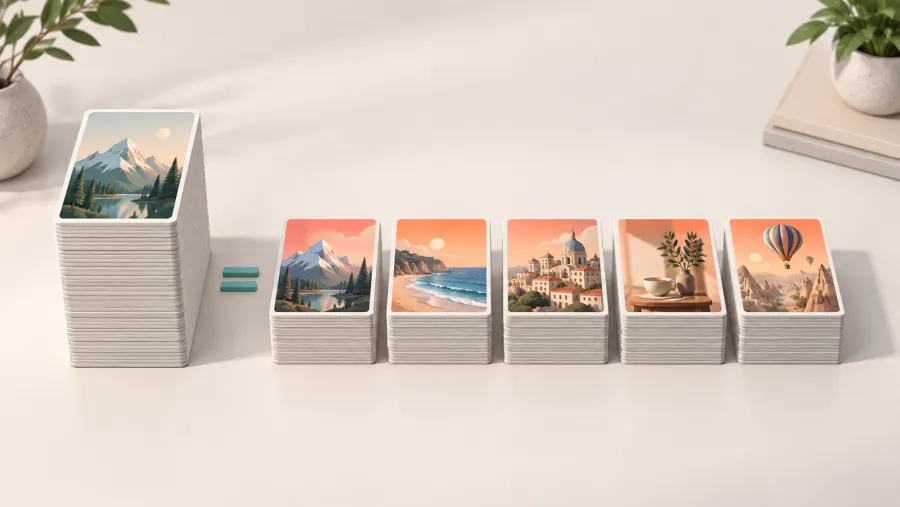
Any series has about thirty images. With one scene, all thirty develop one subject. With five scenes, the same thirty images are spread across five subjects.
So the number of scenes changes not the number of pictures — that stays roughly the same — but the range: how many different images the series is spread across.
Fewer scenes — each subject is worked out more deeply: it gets more images and more variations to choose from. More scenes — a wider range of images: the series covers several topics at once. This is not “better or worse” — these are different tasks.
A technique: scenes as sections
The most practical use of several scenes is visual sections. Say a channel has three formats: breakdowns, news, personal stories. Three scenes give three distinct images within one style — and viewers understand at a glance what kind of material is in front of them, before they read the title. The feed stays coherent: one style, different subjects.
The same technique works for a podcast with different episode types, a blog with several topics, a course with modules: one scene per section, the whole project in one visual language.
You do not have to invent anything
You do not need to make up subjects. Each scene is already filled with a suggestion — a ready subject prepared for the chosen style. You can refresh the suggestion — the service will offer several scenarios to choose from — keep it, edit it or write your own subject in your own words: the series will be built around it. Finding subjects is our job; yours is to decide how many you need.
One simple rule to finish. One steady format — take one scene and get depth. Several sections or topics — take as many scenes as there are sections, and the series will sort itself across them.