«Wide shot: a city of the future built of towers from one architectural family — different in height and shape but with one character of line and the same warm light in the windows; cinematic evening light, one even formation of clouds.»
Describe your own scene — and get a series in the chosen style
Open the “Concept Art” styleWhat a style is in COVERPRESS and why it turns pictures into a series
In brief
A style is the mechanism of unity. A fixed layout turns a set of pictures into a series. · The library is ours; every style has been selected and tuned by us. Hundreds of styles, and the library keeps growing. · Choose by fit with the project, not by “pretty”. Shelves and live samples are there for that.
Why it matters most in a series
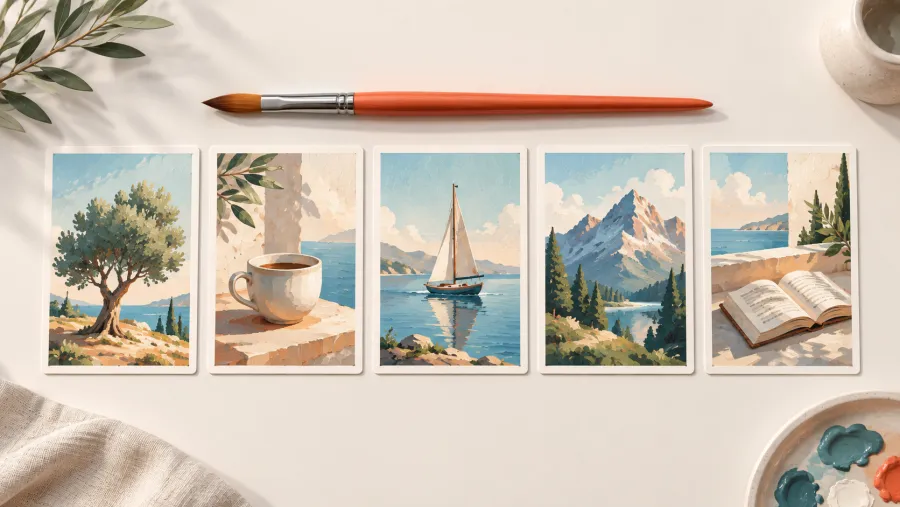
A series differs from a set of pictures in exactly one thing — unity. You can gather thirty beautiful images, and they will remain thirty beautiful images. Or you can get thirty images in which one hand is visible at first glance: one manner, one color range, one character of light. Then a channel, a podcast or a bookshelf looks like one project — and viewers recognize you before they read the title.
A style is the mechanism of that unity. It is fixed: every style has a layout — a short description of its character: technique, palette, mood, composition. It is a reference for choosing, and it cannot be changed — the unchanging visual language is what gives the series its unity. Within a style the subjects change (that is what scenes do), but the language stays the same.
Where styles come from
The style library is our own. Every style has been selected and tuned by us: weak and derivative options are weeded out before you open the page. The library holds hundreds of styles, and it keeps growing, partly in response to what clients are interested in.
Each style page has live samples: real images of ours, not pictures from the internet or stock sites. They show how the style behaves on different subjects — which is more honest than any description.
How to choose yours
The first rule: do not choose by “pretty / not pretty” but by fit with the project and the audience. The library has many beautiful styles — the question is which of them will speak to your viewers in their language. Serious popular science and a children’s podcast need different visual languages, even if both styles are good.
Go by the layout: technique and palette hint at the character, mood at the tone, composition at how the style will look in your format. Shelves help narrow the search: go to your manner — painting, 3D, minimalism, retro — instead of scrolling through everything. And signed-in clients can mark styles they like and come back to their collection without searching again.
And remember: a style is not a lifelong choice. One series — one style; the next one can be made in another. Some tasks ask for difference on their own: a strict series for lectures and a warm one for a personal blog.
What next
Once the style is chosen, all that is left is to set the scenes — the subjects the series will be spread across — and choose the format. And the easiest place to start is the library itself: browse the shelves and look at the live samples.