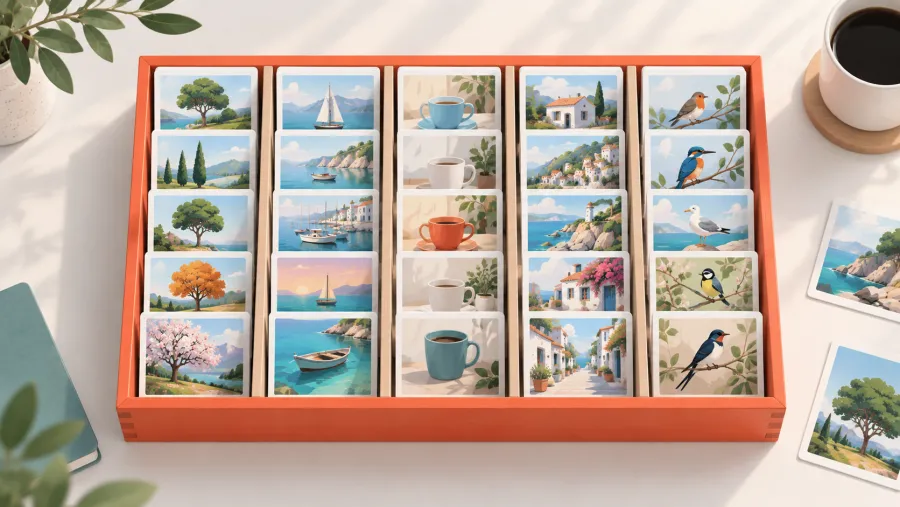
How five scenes become thirty images in one style
In brief
The style holds it together. Technique, palette, light and composition are the same for the whole series — so thirty images read as one line. · Scenes and variants give variety. Scenes divide the series by subject, and within a scene each image is its own variant of the subject, with no repeats. · Decisions are yours, the work is ours. You choose the style, the number of scenes and the format; the service prepares the suggested subjects and the images themselves.
A series has three levels
From the outside a series looks simple: choose a style, set scenes, get an archive. Inside it has three levels, and each is responsible for its own part.
The style answers the question “how is it drawn”. It is shared by the whole series.
The scene answers the question “what is drawn” in its part of the series. There are one to five scenes.
The image is a specific variant of its scene’s subject. A series has about thirty of them.
The unity of a series lives on the first level, variety on the second and third. That is why a series neither falls apart into random pictures nor turns into thirty copies of one: the language is shared, the subjects and variants are different.
The style: what does not change
A style is a single visual language: technique, palette, light, composition, mood. Every style has a layout — a short note on its character, and it cannot be changed. This is not a limitation but the mechanism itself: precisely because the language is fixed, thirty images come out as a series rather than a set.
Every style in the library has been selected and tuned by us — you choose a language that has already been tested rather than assembling it from settings. What a style is made of is covered in detail in a separate article.
Scenes: what the series is divided into
A scene is a separate subject within a style. The roughly thirty images of a series are spread across the scenes: with one scene, the whole series develops one subject; with five scenes, there are five subjects, each with its own group of images in the same manner.
The scenes do not have to be connected to each other. Each is a standalone subject: you can make them close or completely different, for different sections of the project. The series is united by the style, not by a storyline.
The number of scenes is a decision about range. Fewer scenes — each subject is developed more deeply: it gets more variants. More scenes — a wider range: the series covers several topics at once. How many scenes to take for your project is covered in the article on scenes.
Inside a scene: variants of one subject
The third level is the one most often overlooked. A scene is not one picture repeated several times. Each image in a scene is its own variant of the scene’s subject, and there are no repeats in a series: all the images are unique.
This has a practical benefit. If a project has one constant topic — for example, podcast episodes on one subject — one scene gives you a stock of different images on one subject: the episodes differ, and the feed stays even. If there are several sections, the scenes give each its own look, and the variants within a scene keep a section from getting stale.
Who does what
The division is simple: the decisions are yours, the work is ours.
You decide. Which style. How many scenes. Which format — horizontal, square or vertical, one for the whole series. And, if you like, which subjects: any scene can be described in your own words.
The service does. For each scene it prepares a suggestion — a ready subject for the chosen style. At your request it refreshes it and offers several scenarios to choose from. It draws about thirty images in one style, making sure they do not repeat.
You do not need to phrase anything “correctly”. You can accept a suggestion as it is — that is a full path, not a simplified one. You can change a couple of words. You can write the subject in plain language — the series will be built around it. How to work with suggestions if you want to take a bigger part — three ways, step by step.
What you end up with
About thirty images in one style and one format, each of them unique. The standard time is up to 24 hours. The archive appears in your account, and the link arrives by email. The images of a series are created for you, are not passed on to anyone else and never go into the stock library.
What else the order includes and how to handle the archive afterwards — the full contents of a series.